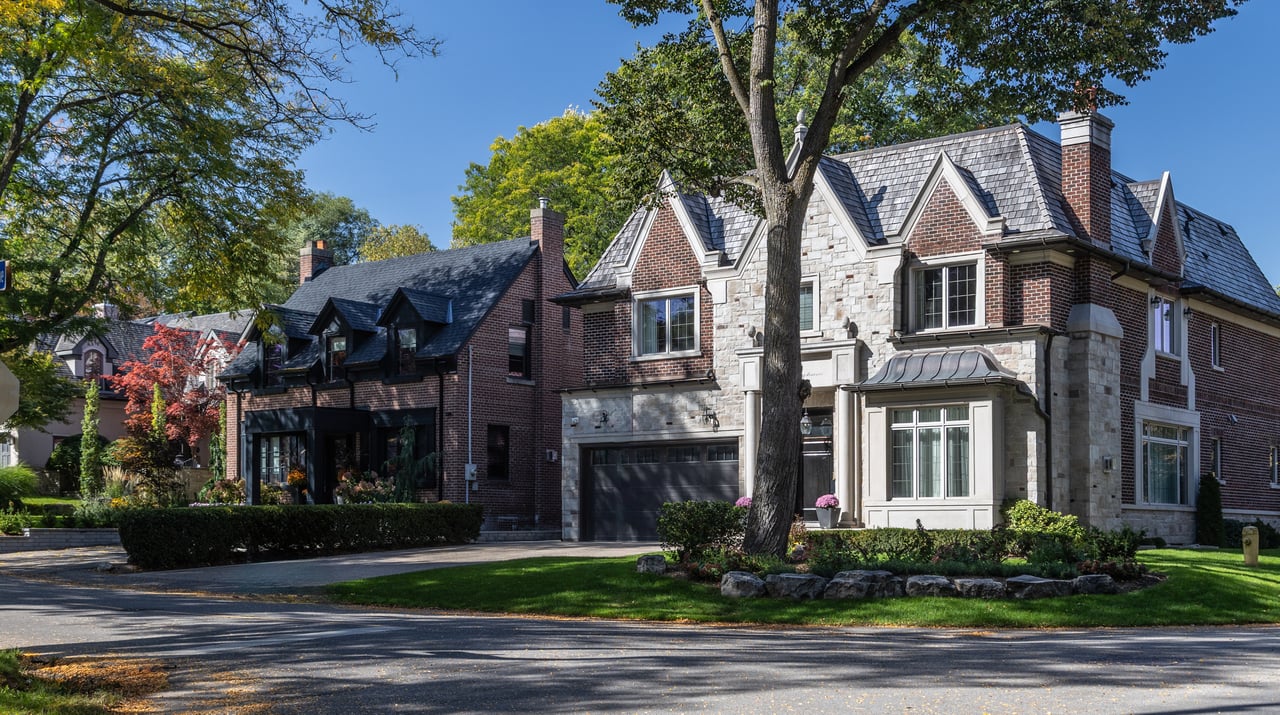
On a weekday morning at Bathurst and Eglinton, a Forest Hill resident who used to check a bus schedule now walks down an escalator instead. That's the whole shift in one image. For as long as most people in this neighbourhood have owned property here, "getting across town" meant a bus in mixed traffic, a transfer, and a guess about timing. Since February 8, 2026, it has meant a train running underground, with its own platform at Bathurst and Eglinton carrying Forest Hill's name.
Line 5 Eglinton, the Crosstown, took roughly fifteen years to go from groundbreaking to opening day. Seven months in, the daily-life questions worth asking aren't about the ribbon-cutting. They're about what a resident on either side of this neighbourhood actually does differently on a Tuesday.
A Neighbourhood With Two Front Doors
Most coverage of the Crosstown treats it as one line with 25 stops, Forest Hill being a single dot among them. That misses the more useful detail for anyone who actually lives here: the station order runs Cedarvale, then Forest Hill, then Chaplin, with the three sitting close enough together that Forest Hill's own platform is flanked on both sides by a different kind of neighbourhood.
West through Cedarvale, the line opens onto Oakwood and the Little Jamaica corridor. East through Chaplin, it opens onto the stretch known locally as The Eglinton Way, a run of restaurants between Chaplin Crescent and Oriole Parkway that has operated for years without any transit stop of its own. Depending on which end of Forest Hill someone lives closer to, "taking the LRT" now means something genuinely different. That's not a detail most write-ups about opening day bothered to work out, because it only matters if you're the one deciding which entrance to walk toward.
Fifteen Years to Get Here
The wait wasn't quiet. Years before opening day, Metrolinx proposed closing Bathurst Street one block north of Eglinton for seven months to speed up construction at the future Forest Hill station, back when the project's completion was still pegged to September 2021. Several hundred residents and business owners packed into Beth Tzedec Congregation for a town hall on the plan. Metrolinx reversed the closure before the meeting even started, acknowledging it hadn't handled the community engagement well.
That single meeting is a useful marker for how long this stretch of Eglinton lived with construction fencing, detours, and a moving completion date. The station itself required expropriating properties at 842 and at 874-876 Eglinton Avenue West for the entrance, vent shafts, and a power substation, work that displaced existing storefronts along that block. By the time trains actually started running, the neighbourhood had absorbed roughly five more years of construction than the original timeline promised.
What the Clock Actually Says Now
The headline number from the Crosstown's opening coverage is the end-to-end travel time across the full 19-kilometre line: Kennedy Station to Mount Dennis now runs approximately 50 to 55 minutes by train, compared with up to 105 minutes on the bus routes it replaced.
| Before (bus) | Now (Line 5) | |
|---|---|---|
| Kennedy to Mount Dennis, end to end | Up to 105 minutes | Approximately 50-55 minutes |
| Current service hours | N/A | 5:30 a.m.-11 p.m. Mon-Sat, 7:30 a.m.-11 p.m. Sun |
That table's second row matters as much as the first. What opened in February wasn't the finished product. Metrolinx and the TTC described it as a phased start, with the full timetable and a projected weekday ridership of roughly 123,000 riders expected within three to six months of opening. Count forward from February 8 and that window closed sometime between May and August. Writing this in September, Forest Hill residents should now be riding something close to the service level that was originally promised, not the thinner schedule from opening week. If a commute still feels off, that's worth flagging to the TTC rather than chalking up to a new system finding its legs.
Cedarvale Side: A Different Kind of Errand Run
Head west from Forest Hill station and the first stop, Cedarvale, does double duty as the interchange with Line 1, meaning a resident near the Bathurst end of the neighbourhood can now reach the Yonge subway without a bus at all. Cedarvale's platform also carries a public art installation called Super Signals, by the Canadian artist Douglas Coupland.
Keep going west past Cedarvale and Oakwood station opens onto Little Jamaica, home to the Reggae Lane mural and to restaurants like RAP's Food, known for jerk chicken and oxtail. Along the same general stretch of Eglinton that Forest Hill station now serves sits Jerusalem Restaurant, a Middle Eastern spot that has been in business for more than 40 years and remains a fixture along that corridor. None of this required a car before February. It just required patience with a bus that didn't have its own right of way.
Chaplin Side: The Eglinton Way, Two Minutes Underground
The other direction tells a completely different story. Chaplin station sits at the edge of what locals call The Eglinton Way, a nine-block dining strip running between Chaplin Crescent and Oriole Parkway in north Forest Hill. This stretch was never hard to walk to. It was hard to reach quickly from anywhere else, which meant it functioned more as a destination for people already in the immediate area than a stop on the way to somewhere else.
That's the strip where Ferraro 502 has served wood-fired pizza rooted in a family recipe from Altomonte, Cosenza, for generations, where Rimini Rimini has brought Italian and Greek seafood since opening in December 2022, and where Hay Sushi and Thairoomgrand round out a corridor with real range. The Abbot on Eglinton, with its dozen Canadian craft beers and a fireplace for winter, sits along the same stretch. A resident on the Chaplin side of Forest Hill can now reach this strip, or leave it, on a schedule that doesn't depend on Eglinton Avenue traffic.
What Hasn't Moved
Not everything in Forest Hill runs on the new schedule. Forest Hill Village, centred on Spadina Road and Lonsdale Avenue, sits south of both stations and has no direct stop of its own. The café and shop routine that defines a slow Saturday in the Village hasn't changed because the LRT doesn't reach it. That's worth saying plainly, because it's easy to assume a neighbourhood-wide transit opening touches every corner of a neighbourhood evenly. Here, it touches the north edge hard and leaves the Village center exactly as it was.
That unevenness is itself the more honest way to describe what happened this year. Forest Hill didn't get "transit." It got two specific platforms, each connecting to a different slice of the city, while the part of the neighbourhood most associated with its identity kept running on foot traffic and word of mouth, same as it always has.
Seven Months In, the Real Question Is Which Half You Live In
The easy version of this story says Forest Hill finally has rapid transit and leaves it there. The more useful version, for someone who already has a key to a house here, is that the answer to "how has this changed my week" depends entirely on whether Bathurst or Chaplin Crescent is the closer walk. One direction now puts Little Jamaica and the Line 1 subway within reach without a car. The other puts a nine-block dining strip that used to require a deliberate trip within a couple of minutes underground. Both are real. Neither is the whole picture on its own.
If you're weighing what any of this means for a property you already own in Forest Hill, or you're curious how the neighbourhood's two ends compare for daily life, Anita Springate-Renaud has spent years watching how infrastructure like this actually plays out on the ground here. Reach out any time you'd like to talk through it.