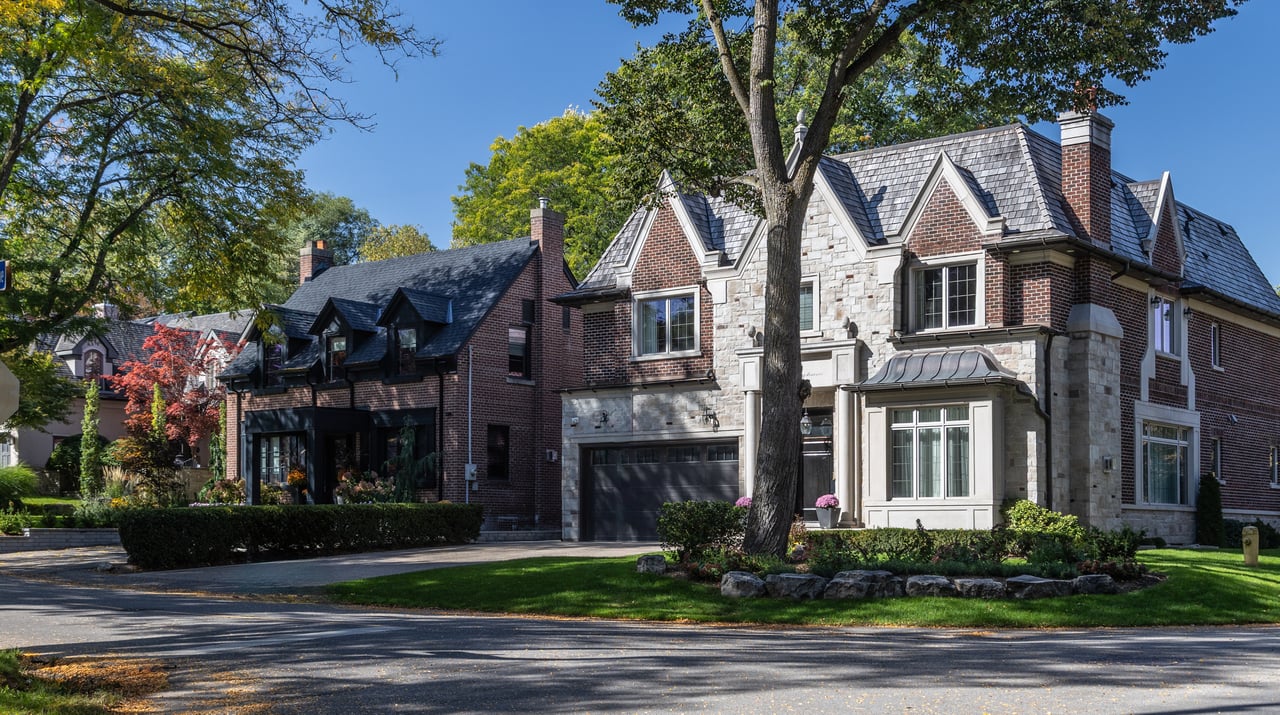
In January 2026, Toronto City Council voted to refuse an alteration to a designated heritage house on Drumsnab Road in South Rosedale. Five months later, in June, the city's own heritage planning staff recommended conditional approval for a revised application at 2 Whitney Avenue in North Rosedale, a property its own heritage conservation district plan classifies as a "landmark of significant merit" of "citywide significance." Same city. Same section of the Ontario Heritage Act. Two comparable Rosedale addresses. One got a flat no from Council. The other, redesigned, got a green light from staff on its second attempt.
If you are looking at a detached home in Rosedale and assuming you will sort out the renovation once you close, these two outcomes are worth sitting with. Heritage approval here is not a checklist you clear once and forget. It is a judgment call made property by property, and it is only one of two separate regulatory systems your address may answer to. Buyers who treat "heritage" and "ravine" as the same conversation are underwriting their renovation budget with the wrong set of rules.
Two Heritage Districts, Reviewed Separately
Rosedale contains two formally designated Heritage Conservation Districts under Part V of the Ontario Heritage Act: North Rosedale and South Rosedale. Each has its own council-approved HCD Plan, its own residents' association, and its own point of contact at the city. South Rosedale's heritage planning file, for instance, runs through Will Thomas, Assistant Heritage Planner at the City's Heritage Preservation Services unit. A heritage permit is required for any work that changes the street-facing appearance of a house in either district, rated or unrated, in addition to any standard building permit. That covers windows, doors, railings, and exterior elevation features, not just additions.
This layer answers one question: can you change how the house looks from the street. It has nothing to say about what happens in the backyard, which is where the second rulebook takes over.
The Ravine Bylaw Doesn't Care About Your Facade
Toronto's Ravine and Natural Feature Protection Bylaw, Chapter 658 of the Municipal Code, governs grading, tree removal, drainage, and construction within a mapped ravine protection area. It is triggered by location, not heritage status or design. A property with no heritage rating at all can still fall inside a ravine setback and face the same review.
The bylaw is also stricter than Toronto's general Private Tree Bylaw. Outside a ravine zone, protection kicks in at a 30-centimetre trunk diameter. Inside a ravine zone under Chapter 658, a tree of any size can require a permit before you touch it. That distinction matters in Rosedale specifically, where the tree canopy isn't incidental scenery. According to the North Rosedale Residents' Association, North Rosedale's measured tree canopy stood at 66 percent as of 2025, the highest in the city outside High Park.
Here is how the two layers actually stack, side by side:
| Layer | Governs | Reviewed by | Triggered by |
|---|---|---|---|
| Heritage Permit (North or South Rosedale HCD) | Street-visible exterior changes: windows, doors, facade, additions | City Heritage Preservation Services | Location inside the designated HCD boundary |
| Ravine and Natural Feature Protection Bylaw, Chapter 658 | Grading, tree removal, drainage, construction within a ravine setback | City's Ravine and Natural Feature Protection service counter, Urban Forestry | Proximity to a mapped ravine, regardless of heritage rating |
| Conservation authority review | Slope stability, drainage, work near a regulated watercourse | Toronto and Region Conservation Authority | Property adjacent to a regulated valley or watercourse |
A house can clear heritage review and still stall on the ravine side. It can also sit entirely outside the ravine boundary and still need heritage sign-off for a new front door. The two systems run on different maps.
What the Two Layers Cost in a Real Project
This is where the abstraction becomes a budget line. One documented Rosedale addition spent $40,000 to $60,000 plus HST and fourteen months on design and planning alone, before an architect was even engaged, confirming feasibility and cost before committing to a design. Design and planning for heritage-district projects in Rosedale typically runs 8 to 12 months. This particular project ran to 14 because of extended Committee of Adjustment and heritage review.
That is planning time, not construction time. And the penalty for skipping the process is not abstract either. Chapter 658 itself sets out that a person who contravenes the bylaw is guilty of an offence subject to a special fine of $100,000. That is the exposure for removing a protected tree or altering grade in a ravine setback without a permit, on top of any stop-work order or remediation the city can require.
None of this shows up in a listing description. It shows up in the first conversation with a contractor after closing.
Two Decisions From This Year Show How the Judgment Actually Works
The Drumsnab Road refusal involved a B-rated property in the South Rosedale HCD. The staff report recommending refusal went to Council on January 20, 2026, and Council adopted it, with direction to oppose any appeal to the Ontario Land Tribunal.
The Whitney Avenue file tells a different story with the same starting point. The property is also B-rated, in the North Rosedale HCD. An earlier proposal to build a structure on land covered by an encroachment agreement was refused by Council in October 2025. The applicant came back with a revised design, submitted June 23, 2026, and staff recommended approval subject to conditions, finding the new version complied with the North Rosedale District Plan, the Parks Canada Standards and Guidelines for the Conservation of Historic Places in Canada, and the Official Plan.
Same rating category. Same general geography. One outcome was a flat no. The other was a no that became a conditional yes once the design changed. That is the pattern worth internalizing before you write an offer: heritage approval in Rosedale is not a fixed target you hit by following a template. It is negotiated, and it can go either way on the same type of property.
What to Confirm Before You Waive Conditions
Before removing a financing or inspection condition on a Rosedale property, especially one that backs onto a ravine, it is worth confirming a few things directly rather than assuming:
- The property's heritage rating, if any, through the Heritage Register, and whether it sits in North Rosedale HCD, South Rosedale HCD, or neither
- Any prior heritage permits, building permits, or Committee of Adjustment decisions tied to the address, which often set precedent for what the city will and won't approve next
- Whether any portion of the lot falls inside the Ravine and Natural Feature Protection boundary, which the city's mapping tool can confirm by address
- A current survey and title search, since easements or heritage agreements are not unusual on older Rosedale parcels
- Whether the scope you're picturing would require a tree inventory, tree protection plan, or grading plan, all of which the city's ravine permit application process requires before it will even review a request
None of these take long to check. Skipping them is what turns a straightforward purchase into a project that runs a year longer and costs tens of thousands more than the buyer expected.
The View Is the Value, and the Rule
The canopy, the privacy, and the ravine outlook are real parts of what makes a Rosedale property desirable, and they are not going away. But the same features that draw a buyer to a ravine lot are exactly what triggers the bylaw that has nothing to do with heritage character. Treating heritage review as the only hurdle, and assuming a ravine-backing lot is otherwise a normal renovation, is where the surprise comes from. The two systems are separate, they are reviewed by different city offices, and as this year's Council decisions show, satisfying one does not guarantee anything from the other.
Common Questions
Does every Rosedale property fall under a Heritage Conservation District? No. North Rosedale and South Rosedale are each designated HCDs, but not every adjacent street falls inside either boundary. Some individual properties nearby are listed on the city's Heritage Register independently of district designation, which is worth checking address by address.
Does the ravine bylaw apply if my home has no heritage rating? Yes. Chapter 658 is triggered by a property's proximity to a mapped ravine or natural feature, not by heritage status. An unrated home backing onto a ravine can face the same review as a heritage-designated one.
How much lead time should I plan for permits before starting work? Based on documented Rosedale projects, 8 to 14 months for design and heritage or Committee of Adjustment review is a realistic range, before construction begins.
If you are weighing an offer on a ravine-adjacent property in Rosedale, or trying to work out what a specific address will and won't let you build, these are exactly the kinds of questions worth answering before conditions come off. You can browse the neighbourhood's character and more on Rosedale ravine living or explore the Rosedale neighbourhood guide for more context. When you're ready to talk through a specific property, Anita Springate-Renaud and her team can help you read the permit history before you write the offer. Let's Connect.