Wondering why one Forest Hill home feels storybook and private while another feels formal, symmetrical, or distinctly urban? In this neighbourhood, architectural style is more than curb appeal. It can shape how a home lives, how much upkeep it may need, and what kind of buying decisions deserve a closer look. If you are considering a move in Forest Hill, understanding these style cues can help you read listings more clearly and narrow in on the right fit. Let’s dive in.
Why Forest Hill Has A Distinct Look
Forest Hill developed differently from a typical grid-based suburb. City heritage records show the area grew as an upscale residential enclave in the early 20th century, with by-laws that controlled the size, cost, and design of new homes.
Those rules went well beyond basic planning. The City records note requirements for architect-designed street elevations and even a Board of Architects that reviewed new residential construction. That early oversight helps explain why so many homes still feel intentional, cohesive, and design-led today.
The street pattern adds to that character. Old Forest Hill Road follows an older trail route described by the City as one of Toronto’s earliest roads, while the village core developed around Spadina Road and Lonsdale Avenue.
Today, Forest Hill Village still reads as a distinct main street area with commercial and residential uses. Around it, you will find a mix of single-detached homes, semi-detached homes, townhouses, and walk-up apartments. For buyers, that means the neighbourhood offers more than one housing experience, even within a relatively compact area.
Tudor Revival In Forest Hill
Among Forest Hill’s most recognizable homes are Period Revival houses, especially Tudor Revival. In a City proceeding related to 276 Forest Hill Road, City evidence identified Georgian Revival and Tudor Revival as dominant architectural styles in the Forest Hill Village area.
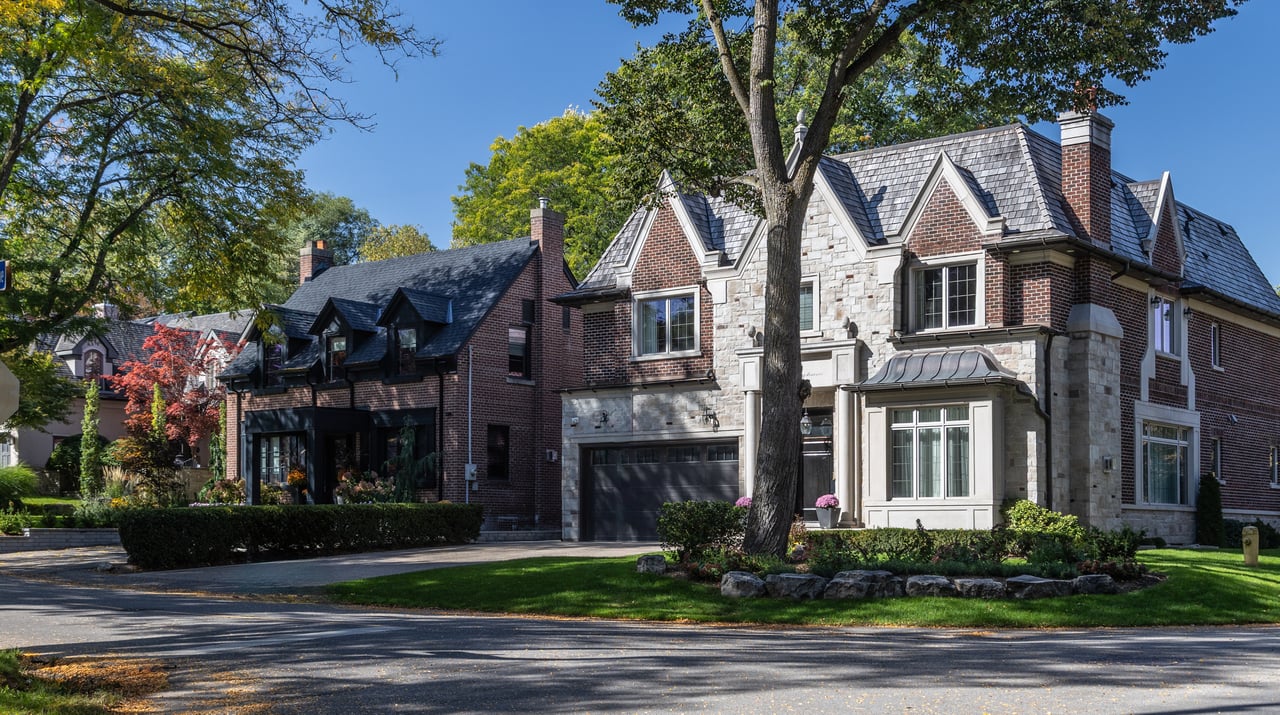
If you are scanning listings, Tudor Revival homes often stand out quickly. Common visual markers include steeply pitched roofs, prominent chimneys, half-timbering, stone or stucco cladding, bay or oriel windows, and landscaped setbacks.
These homes often feel layered rather than open and minimal. Based on City heritage descriptions, you can generally expect asymmetrical massing, recessed entries, and a stronger connection to the garden setting.
For daily living, that can translate into more separated rooms and a greater sense of privacy. If you like homes with character and a distinct relationship to the lot, this style may appeal to you.
What Tudor Revival Can Mean For Buyers
The same features that create charm can also influence maintenance. Complex rooflines, chimneys, masonry, wood trim, half-timbering, and older window patterns may require more careful upkeep over time.
That does not make these homes less desirable. It simply means you should look at the exterior with as much attention as the interiors. In Forest Hill, architecture often tells you something meaningful about future ownership responsibilities.
Arts And Crafts On Older Streets
Forest Hill also includes important Arts and Crafts houses, especially on older residential streets north of St. Clair. The City’s Eden Smith survey identifies examples on Forest Hill Road, Russell Hill Road, and Warren Road.
These houses are often among the neighbourhood’s earliest and most expressive homes. The City descriptions point to steep roofs, tall chimneys, mixed materials, and multi-paned windows.
Just as important, many of these homes respond to the site’s topography and garden setting instead of forming a rigid street wall. That can create a softer, more organic relationship between house, lot, and landscape.
What Arts And Crafts Can Mean For Buyers
If you are used to contemporary layouts, these homes may feel more segmented and intimate. Their planning often reflects the era in which they were built, with a stronger sense of individual rooms and a more garden-oriented siting.
That can be a real benefit if you value character, privacy, and architectural detail. At the same time, the mix of materials and older construction elements may call for a more diligent review of the home’s condition and upkeep needs.
Georgian Revival And Modern Georgian
Not every classic Forest Hill home is steep-gabled or asymmetrical. Some of the neighbourhood’s most refined houses draw from Georgian Revival and Modern Georgian traditions.
These homes usually present a more formal and balanced street presence. The City describes the Alfred D. Morrow House at 276 Forest Hill Road as Modern Georgian, a 1930s reinterpretation of Georgian Revival with symmetry, classical detailing, and a simplified modern roofline and rear composition.
In practical terms, this style often signals order and restraint. If you are viewing a home with a symmetrical facade, classical trim, and a composed overall profile, you may be looking at a Georgian or Modern Georgian influence.
What Georgian Styles Can Mean For Buyers
For many buyers, these homes feel timeless and easy to read. The layout often suggests classical proportions and more orderly room planning, which can create a traditional feel without heavy ornament.
That said, buyers should still inspect key building elements carefully. Flat roofs, masonry, and custom glazing can all deserve close attention, especially in older or extensively customized homes.
Village-Core Apartments And Mixed-Use Buildings
Forest Hill is not only about large detached houses. Around Spadina Road and Lonsdale Avenue, the neighbourhood shifts into a more urban village environment.
The City describes Forest Hill Village as a main street area with both commercial and residential uses. Heritage documentation also points to pre-war apartments, commercial rows, and later modernist elements as part of that built fabric.
For buyers, this part of Forest Hill can offer a very different lifestyle. Instead of an estate-like streetscape, you may find smaller-footprint living, shared walls, and easier access to everyday services.
What Village-Core Living Can Mean For Buyers
Pre-war apartments and village-edge mixed-use buildings often mean less yard maintenance and more walkable convenience. City materials describe these buildings as generally 2.5 to 5 storeys, typically in brick masonry with stone or terra-cotta detailing, and often organized around central entrances, courtyards, or light wells.
If you want Forest Hill access with a more compact living arrangement, this housing type may be worth serious consideration. It can be especially relevant if your priority is location and ease rather than a larger freehold footprint.
Newer Infill And Replacement Houses
Forest Hill also includes a visible contrast between historic homes and newer custom builds. City and appeal records reference replacement-house proposals on streets such as Forest Hill Road and Rosemary Lane, while recent City planning work notes that development interest is spreading beyond the immediate St. Clair and Bathurst area.
For buyers, this means you may see very different housing products on the same street. One home may reflect early 20th-century craftsmanship, while the next may be a newer three-storey build designed to maximize the lot.
What Newer Builds Can Mean For Buyers
Newer infill and custom rebuilds often offer larger footprints, multiple storeys, and more current mechanical systems. That can appeal to buyers who want modern interiors and potentially simpler day-to-day maintenance.
The tradeoff is often architectural feel. Newer homes may have less of the handcrafted detail and historic identity that define much of Forest Hill’s long-standing appeal.
City planning materials also show that replacement-house projects are evaluated for neighbourhood fit, height, density, tree impacts, and ravine protection. That matters if you are buying near an active redevelopment site or weighing the long-term context of a street.
How To Read Forest Hill Listings Better
In Forest Hill, style cues can reveal more than design taste. They can give you useful clues about layout, maintenance, and the kind of ownership experience a property may offer.
Here are a few quick ways to interpret what you are seeing:
- Steep gables, chimneys, and half-timbering often point to Tudor Revival or related Period Revival design.
- Symmetry and classical trim often suggest Georgian Revival or Modern Georgian influences.
- Asymmetrical form and mixed materials often signal Arts and Crafts character.
- Smaller-scale buildings near the village core may indicate pre-war apartment or mixed-use living with a more urban rhythm.
- Larger, more recent structures may reflect newer infill or replacement-house development.
On streets such as Old Forest Hill Road, Rosemary Lane, Vesta Drive, Forest Hill Road, Russell Hill Road, and Warren Road, those visual cues can be especially useful. In many cases, they hint at how the home was originally planned and how much exterior attention it may require over time.
Check Heritage Status Early
One of the most practical steps in Forest Hill is checking heritage status early in your search. The City of Toronto says properties on the Heritage Register are conserved and maintained under Official Plan heritage policies.
That matters because alterations or demolition can trigger City review, especially for designated properties. In Forest Hill, some homes are individually designated, some are listed, and others sit on streets where heritage context strongly influences what may be built nearby.
For buyers, this is not just a legal detail. It can shape renovation plans, approval timelines, and even how the surrounding streetscape may evolve. The earlier you understand that context, the better positioned you are to make a confident decision.
What Buyers Should Focus On Most
In Forest Hill, architecture is not just about appearance. It often affects how a home functions, what ownership may involve, and how well a property aligns with your priorities.
If you love historic character, you may be drawn to Tudor Revival or Arts and Crafts houses, knowing they may come with more exterior upkeep. If you prefer formal balance, Georgian and Modern Georgian homes may feel like the right match. If convenience and lower-maintenance living matter most, village-core apartments or mixed-use buildings may deserve a closer look.
The key is matching the home’s style to your lifestyle, your tolerance for maintenance, and your long-term plans. In a neighbourhood as layered as Forest Hill, that clarity can make your search much more efficient.
If you are considering a move in Forest Hill and want clear, discreet guidance on how a home’s architecture, setting, and context may affect value and fit, connect with Anita Springate-Renaud.
FAQs
What architectural styles are most common in Forest Hill?
- In Forest Hill, buyers are most likely to encounter Tudor Revival, Arts and Crafts, Georgian Revival, Modern Georgian, pre-war apartments, village-core mixed-use buildings, and newer infill or replacement houses.
What does Tudor Revival architecture usually mean for a Forest Hill buyer?
- In Forest Hill, Tudor Revival homes often suggest steep roofs, chimneys, half-timbering, more separated room layouts, and potentially more exterior maintenance over time.
What should buyers know about Arts and Crafts homes in Forest Hill?
- In Forest Hill, Arts and Crafts homes often feature mixed materials, tall chimneys, multi-paned windows, and a site-sensitive layout that may feel more private and garden-oriented.
What does Georgian or Modern Georgian style signal in Forest Hill?
- In Forest Hill, Georgian and Modern Georgian homes often signal symmetry, classical detailing, and a more formal, orderly feel both outside and in the layout.
What kind of housing is found in Forest Hill Village?
- In Forest Hill Village, buyers may find pre-war apartments and mixed-use buildings that typically offer smaller footprints, shared walls, and easier access to everyday services.
Why is heritage status important when buying in Forest Hill?
- In Forest Hill, heritage status matters because properties on the Heritage Register may be subject to City review for certain alterations or demolition, which can affect renovation plans and future changes.